Wednesday, 27 August 2014

Old Telegraph Track

On Sunday 17th August we packed up early and topped up the car with Diesel and let the tyres down to 18psi at Bramwell Junction.  Here we met with 5 other couples doing the same and we all travelled together to our first crossing - Palm Creek.  A convoy of 6 cars arrived and 5 of us said "no way" but one (who had experience) said "of course,  we can do this crossing together"  -  it took 1.5 hours to get 6 cars across this first crossing.  Peter went through first, turned his car around so the winch was ready in case it was needed - and it was for 3 of us.


Neil and one of the other drivers checking entry


Actual creek


Nearly to the top

Now Neil's turn to enter

Keep going Neil - will show you the video when we are home.

We all arrived safely to the other side and had another 4 creek crossing,  2 couples decided to stay the night at Dulhunty Creek.  4 of us went on.

Ducie Creek


Entry being checked.  The track was very sandy and the corrugations very deep.  At times the car was on a 20 degree angle,  I thought we would tip over!

 Radiator attached to a tree!
Everything was catered for!  (sic)

All went well until we reached "Gunshot Creek"  3 drivers decided to go and sustained damage to their cars,  Neil and I decided to turn back and use the bypass road,  we drove back to Bramwell Junction for the night.  The other 3 couples went on to finish the track with further challenges and damage.  We met up with 2 of the couples the next night at Punsand Bay Resort.

Entry level was 70 degree angle, Peter slowly taking his car down.


Made it!

Ashton's turn


He made it too.  As one traveller said to Neil and I "Better to be the timid man driving home than the testosterone man walking home."


Friday, 22 August 2014

Bramwell Station

On Saturday 16 August about 9.30am we left Weipa to go to Bramwell Station.  After 72K of corrugation on the Peninsula Development Road we took the shortcut to the Old Telegraph Road at Sudley to Batavia Downs on a 4 wheel drive track and our first stop for morning tea was at Moreton Telegraph Station. 


Termite mounds are everywhere in northern Australia and Cape York, but nowhere on the peninsula are there so many large impressive ones as around Bramwell Junction.  There are about 70 species of termites and although called ants, they are not related to ants at all - their closest relatives are bees and wasps. They eat cellulose which they get from wood, leaves, grass, bark and even cattle and other herbivore droppings.  They live in nests under ground.  The mound is built on top of the nest for ventilation.   Mounds come in different colours depending on the soil used in the construction.  They come in different shapes and sizes.  Termites are an important part of the tropical ecosystems, forming soils and recycling nutrients. 

 
We enjoyed morning tea here at Moreton Telegraph Station originally opened in Sept. 1887.
 
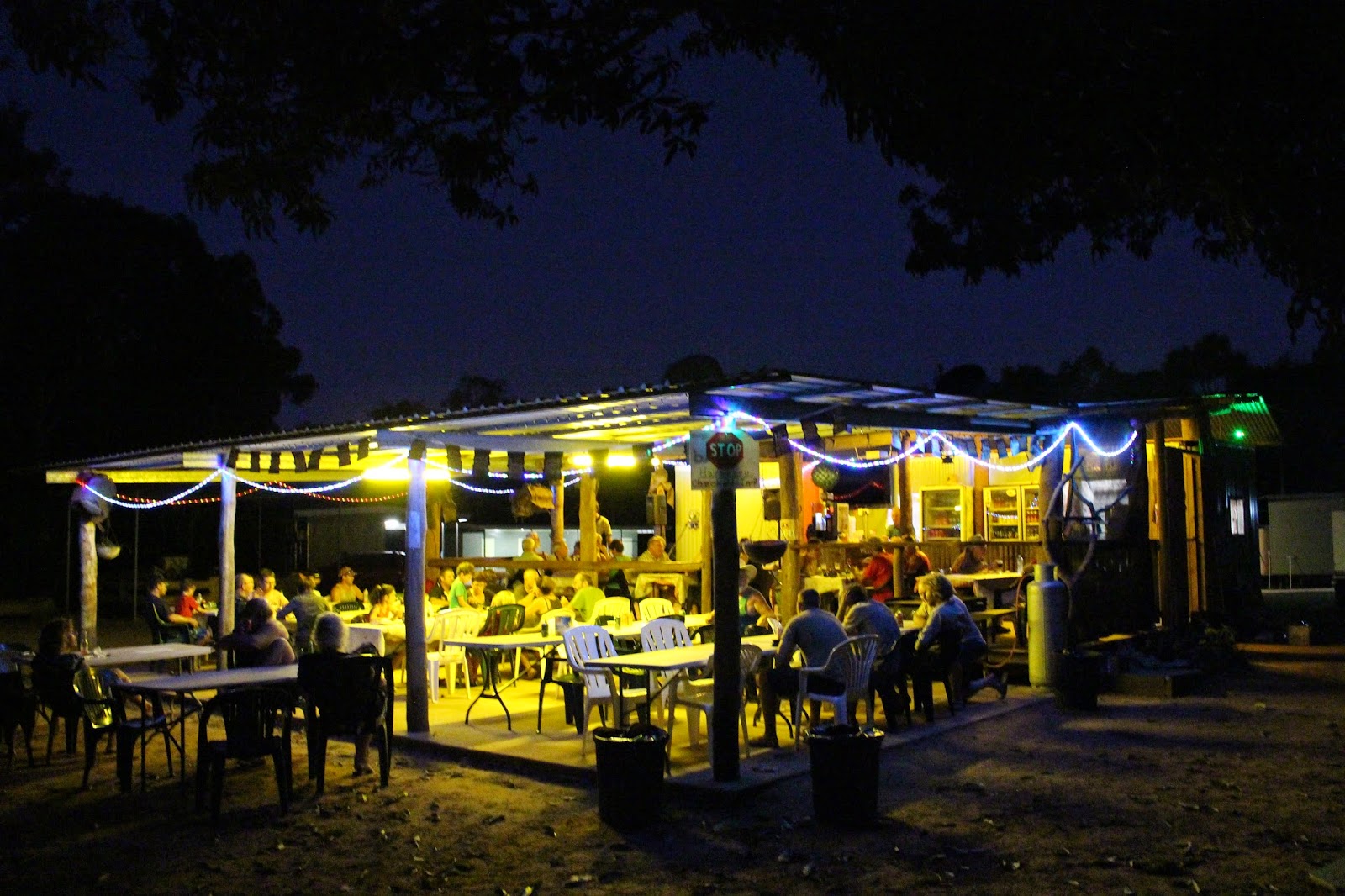
Sunset from Bramwell Station.   Area 1340 sq Km of wild and remote country on the northern Cape - most northern cattle station.  We stayed here for one night, enjoyed a 2 course meal with new friends and some live entertainment with Gary Doyle from Cairns (who was flown up on the mail plane that comes here once a week).


Thursday, 14 August 2014

Mapoon and our first off road recovery!

On Thursday 14 we went for a visit to Mapoon, aboriginal land.   Neil decided to visit the back beach before visiting Cullen Point.  I asked him if  we should let the tyres down as we were on sand, as I completed my sentence - see below. Bogged to the axel!   We did get out eventually. 


Then we had lunch at Cullen Beach (not a sand track)
 
 
Today, 15 August, we are restocking on fuel, water and food as tomorrow we head to Bramwell Station.  We will have no phone or internet for about 3 or 4 days - what a shame.


WE HAVE CROCS!!


Neil bought his in Shepparton 4 years ago for $5,  I bought mine in Cairns for $40!  they actually have a croc shop in Cairns.  The other little croc is coming home to you Michael!

I forgot to tell you about my experience at Merluna station.  Went to the toilet before going to bed about 9pm,  went to flush the toilet when something caught my eye in the bowl,  it was a green frog!  Ladies remember to put the toilet seat down.


Weipa and mine tour

Yesterday (14-8-2014) we went on a tour of the town and mine.  Our guide was very informative and we learnt a lot.  Weipa has a static population of 3200, there is one secondary school, one primary and 2 kinders.   They are all in close proximity so the speed restriction of 40 begins at 7.30am and last all day right up to 4pm.  There are 1030 students at school,  one third of the population! Most of the people work at the mine, either directly or indirectly.   The cost of the average house is $650,000 - $700,000,  all homes come with  swimming pool.    There is one hospital here,  you can live here in Weipa but you cannot be born here - you must fly out to have your baby at another major hospital (Cairns).  There is a public library! 


 Our camp site at Weipa,  the boat is now ours but many people bring up their tinnies, camper trailers, caravans and motor homes!


This is the sunset we see from out tent.  Weather has been so hot - the pool has been magic! 


 Beach during the day, looks so inviting but cannot use.


Accommodation here in Camp ground, you can fly in and stay in these self contained units right on the beach,  air conditioned.


The main shopping centre in Weipa,  one supermarket,  2 dress shops (not good for you Charleen), one bakery, one hairdresser, one shop that has everything for cars, camping you name it.  2 barges arrive from the port each week to deliver here to the supermarket. 


This bridge is 843 metres long,  only one way,  there is also a rail line beside for the mine trains.


At mine,  all different mine locations with either tree or fish names


 Small water carrier called "The bug"

Large water carrier used for keeping dust down.  Water carriers and graders operate 24/7 365 days a year.


Ore carriers operate 24/7 365, 235 ton per load.

Tyres for these cost $11,000 each, 10 on each truck.  Old tyres are used to make retaining walls.


Ore loaders.  Trucks are pressurised and air conditioned, there is a "no windows down" policy.
there are 36-38 different mines in the area. 
Workforce: 30% indigenous, 30% women and rest men.
 A learner works 7 hour shifts but a normal shift is 12 hours (2 day & 2 night shifts and 4 days off)
1600 employees in total, 700 drivers.
Most work here for 10 years, some have been here 40+ years.
Pay $100,000 -$200,000 per annum (Charleen & Mick you are in the work job!)
Most of the drivers are from varied professions - nurses, carpenters, admin.
Rio supplies it employees with Rent assistance, $400 per week for permanent, $500 per week for contractor.
Regardless of what time they come off shift they can get a hot mea.

Our guide explained that  to work as a drive you "leave your brain at home for the day!" because you drive up and down the same route for 12 hours.


Tuesday, 12 August 2014

Weipa!

Finally arrived after travelling for about 150K.  The corrugations on the roads were not as bad up here to Weipa, discovered some local information that by 2020 the road to Weipa with be bitumen. 
 
Traffic lights!   unbelievable, just before you arrive in Weipa  these are for the road trains that come from the Rio Tinto mine.  We are going on a tour of the mine tomorrow (14 August)


Sunset from our camp site on Weipa beach (Mick - camera setting landscape, sunset and warm)